Yes, a deed of trust must be notarized in Utah. Notarization is required for the document to be recorded with the county recorder and establish the lender's lien on the property.
Yes, a deed of trust must be notarized in Utah before it can be recorded with the county and establish a valid lien on the property.
Key Takeaways
- Utah law requires notarization of deeds of trust for valid county recording
- Without notarization, the document cannot be recorded and the lender's lien is unenforceable
- The notary verifies signer identity and willingness, not the document's legal content
- Both in-person and Remote Online Notarization (RON) are accepted in Utah
Need a deed of trust notarized?
NotaryLTD provides professional notarization services 7 days a week in Park City and surrounding areas.
Book NowWhy Deeds of Trust Require Notarization
Deeds of trust require notarization because Utah law mandates that all documents recorded with the county recorder must bear a valid notarial acknowledgment.

A deed of trust is a legal instrument that creates a lien on real property to secure a loan. In order for this lien to be legally effective against third parties, the deed of trust must be recorded in the public records of the county where the property is located. Utah Code Section 57-3-101 requires that any instrument affecting title to real property must be acknowledged by a notary public (or other authorized officer) before it can be accepted for recording.
The notarization serves multiple purposes. First, it provides evidence that the person signing the deed of trust is who they claim to be. The notary verifies the signer's identity through a government-issued photo ID, confirming the signer's name, photograph, and physical description match. Second, the notarization confirms that the signer is executing the document voluntarily and is not being coerced. Third, the notary's seal and signature create a presumption of authenticity that courts recognize.
Without a valid notarization, the county recorder's office will reject the deed of trust. This means the lender cannot establish a recorded lien against the property, which defeats the entire purpose of the security instrument. In practical terms, no lender will fund a loan without a properly notarized deed of trust.
At NotaryLTD, our notary has over 30 years of experience handling deeds of trust and other real estate documents. Commission #742886 ensures your documents meet all Utah requirements for recording.
What Happens Without Notarization
A deed of trust without notarization cannot be recorded, leaving the lender without a legally enforceable lien on the property.
If a deed of trust is signed but not notarized, the document exists as a contract between the parties but cannot be filed with the county recorder. This creates several serious problems. The lender has no recorded lien, which means other creditors could record liens ahead of the lender's interest. The lender also cannot foreclose through the standard non-judicial foreclosure process that Utah's deed of trust statute provides.
For the borrower, an unrecorded deed of trust can create title complications down the line. When you try to sell or refinance the property, a title search may reveal discrepancies between the loan records and the public records. Resolving these discrepancies can delay transactions and require additional legal work.
Improper notarization is just as problematic as no notarization. If the notary fails to properly verify the signer's identity, uses an expired commission, or makes errors in the notarial certificate, the recording may be challenged. This is why it is essential to use a qualified, experienced notary for all real estate documents.
If you discover that a deed of trust was not properly notarized, the document will need to be re-executed and re-notarized. This means all parties must sign again in the presence of a notary. Depending on the circumstances, this can be a simple correction or a complex process involving multiple parties and potential legal review.
The Notarization Process for Deeds of Trust
The notary verifies your identity, confirms you are signing willingly, watches you sign, and then applies their official seal and signature to the notarial certificate.
When you present a deed of trust for notarization, the process follows a specific sequence required by Utah law. First, the notary examines your identification. Utah requires a government-issued photo ID that includes your photograph, signature, and physical description. A valid driver's license or U.S. passport satisfies this requirement. Utah Driving Privilege Cards are not accepted for notarization.
The notary compares the name on your ID to the name on the deed of trust. These must match exactly. If your ID shows your legal name differently than the document (for example, a middle name versus a middle initial), the notary will note this and may require clarification from the title company.
Next, the notary asks you to confirm that you are signing the document voluntarily and that you understand you are executing a deed of trust. The notary is not verifying that you understand the financial terms of the loan, only that you know what type of document you are signing and that you are not being forced to sign.
You then sign the deed of trust in the notary's presence. The notary watches you sign to confirm that the signature is your own and was applied in their presence. After you sign, the notary completes the notarial certificate, applies their official stamp or seal, and signs the certificate. The completed document is now ready for recording.
In-Person vs. Remote Notarization for Deeds of Trust
Both in-person notarization and Remote Online Notarization (RON) are legally valid for deeds of trust in Utah, though lender acceptance varies.
Traditional in-person notarization requires you and the notary to be physically present in the same room. This is the most common method for real estate closings and is accepted by all lenders and title companies. NotaryLTD charges $10 per notarial act for in-person notarization, plus $0.70 per mile for travel to your location.
Remote Online Notarization (RON) allows the notary to verify your identity and witness your signature through a secure audio-video connection. You sign electronically on your screen while the notary applies their electronic seal remotely. RON is authorized under Utah law and produces legally valid notarizations.
However, not all lenders and title companies accept RON for deeds of trust. Before choosing RON for your closing, confirm with your lender and title company that they will accept remotely notarized real estate documents. When RON is accepted, it offers significant convenience, especially for borrowers who cannot easily meet in person.
NotaryLTD offers RON services at $25 per notarial act. Visit our pricing page for complete fee information or contact us to discuss which option is best for your situation.
Need your deed of trust notarized?
We come to you. Available 7 days a week throughout Park City, Summit County, and surrounding areas.
Schedule NotarizationDeed of Trust vs. Mortgage in Utah
Utah uses deeds of trust rather than mortgages, which involves a three-party arrangement and allows for non-judicial foreclosure.
While people often use the terms "mortgage" and "deed of trust" interchangeably, they are different legal instruments. A mortgage involves two parties: the borrower (mortgagor) and the lender (mortgagee). A deed of trust involves three parties: the borrower (trustor), the lender (beneficiary), and an independent trustee who holds the title until the loan is repaid.
Utah is a "deed of trust" state, meaning real estate loans are secured using deeds of trust rather than mortgages. The practical difference is in how foreclosure works. In mortgage states, the lender must go through the court system to foreclose (judicial foreclosure). In deed of trust states like Utah, the trustee can sell the property without going to court (non-judicial foreclosure), which is typically faster.
Both deeds of trust and mortgages require notarization before they can be recorded. The notarization requirements are identical regardless of which instrument is used. The key point for Utah borrowers is that your loan will be secured by a deed of trust, and that deed of trust must be properly notarized and recorded for the transaction to be complete.
Common Notarization Issues With Deeds of Trust
Name discrepancies, expired IDs, and missing signers are the most common issues that can delay or prevent deed of trust notarization.
The most frequent problem is a name mismatch between the signer's ID and the deed of trust. If your driver's license shows "Robert A. Smith" but the deed of trust says "Robert Alan Smith," the notary must address this discrepancy. Some lenders include an "also known as" (AKA) provision in the deed of trust to accommodate common variations. Others require the title company to amend the document.
Expired identification is another common issue. Your ID must be current and valid at the time of notarization. If your driver's license expired last month, the notary cannot accept it. Always check your ID expiration date well before your scheduled closing and renew if necessary.
Missing signers can derail a closing. If the deed of trust requires signatures from both spouses and one is out of town, the signing cannot be completed. In some cases, a power of attorney can be used, but this must be arranged in advance with the lender's approval. The power of attorney itself must also be notarized.
Proper witness requirements occasionally cause confusion. While Utah does not generally require witnesses for deed of trust notarization, some lenders include witness lines in their documents. If witnesses are required, they must be present at the signing and cannot be the notary performing the notarization.
Schedule Your Notarization With NotaryLTD
NotaryLTD provides professional deed of trust notarization throughout Park City, Summit County, Salt Lake, and Wasatch areas seven days a week.
Our notary, with commission #742886 and over 30 years of experience, has handled thousands of deed of trust notarizations across every type of real estate transaction. Whether you are purchasing your first home, refinancing a vacation property, or closing on a commercial loan, we ensure your documents are executed correctly and meet all Utah recording requirements.
We are available Monday through Sunday from 9 AM to 9 PM. Our mobile notary service brings us to your preferred location, whether that is your home, office, the title company, or any other convenient spot. We also offer Remote Online Notarization for borrowers who prefer to sign electronically.
Visit our FAQ page for answers to common notarization questions, or call us directly at 435-565-1333 to schedule your appointment.
Professional deed of trust notarization
30+ years experience, NNA certified, available 7 days a week. We come to your location.
Book NowFrequently Asked Questions
About the Author
Deborah Cuha
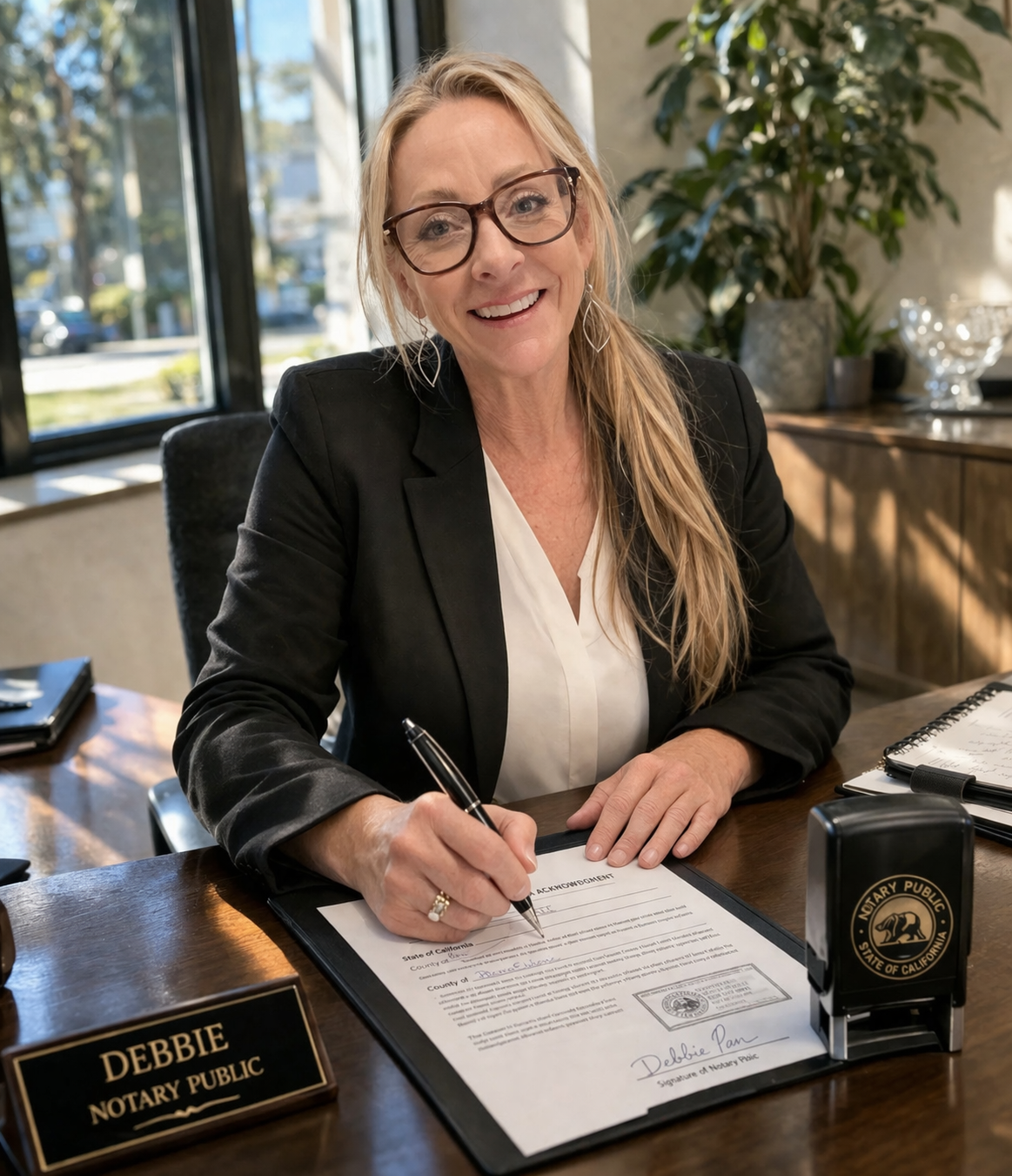
Licensed Utah Notary Public (Commission #742886) with 30+ years of experience. NNA Certified Loan Signing Agent and Certified Remote Signing Agent. Based in Park City, serving Summit, Wasatch, and Salt Lake counties.
Read Full Bio →