Yes, Utah requires power of attorney documents to be notarized to be legally valid. This guide covers the specific requirements, types of POA, costs, and the step-by-step process for getting your power of attorney notarized.
Yes, a power of attorney (POA) must be notarized in Utah to be legally effective. Under Utah's Uniform Power of Attorney Act (Utah Code 75-9), the principal's signature on a power of attorney must be acknowledged before a notary public. Without notarization, third parties such as banks, title companies, and government agencies will likely refuse to honor the document. This guide explains everything you need to know about getting a power of attorney notarized in Utah.
Key Takeaways
- Utah law requires power of attorney documents to be signed and acknowledged before a notary public
- Both durable and non-durable POAs require notarization
- The principal (person granting authority) must appear before the notary with valid ID
- The agent (attorney-in-fact) does not need to be present at the notarization
- Notarization costs $10 per act at NotaryLTD, with mobile and RON options available
- An unnotarized POA will be rejected by most banks, title companies, and government agencies
Need your power of attorney notarized?
NotaryLTD provides professional POA notarization at $10 per act. Mobile, in-office, and RON options available 7 days a week in Park City and surrounding areas.
Book NowWhy Utah Requires Notarization for Power of Attorney
Utah's Uniform Power of Attorney Act, codified in Utah Code Title 75, Chapter 9, mandates that a power of attorney must be signed by the principal and acknowledged before a notary public. The notarization serves multiple critical purposes that protect both the principal and anyone who relies on the POA.

Identity verification is the first purpose. The notary confirms that the person signing the POA is who they claim to be by examining a valid government-issued photo ID. This prevents someone from forging a POA in another person's name. Without notarization, there is no independent verification that the principal actually signed the document.
Voluntary execution is the second purpose. The notary observes the principal during the signing and assesses whether they appear to be acting willingly and free from coercion or duress. If the notary has reason to believe the principal is being pressured or does not understand what they are signing, the notary must refuse to perform the notarization.
Third-party acceptance depends on notarization. Banks, financial institutions, title companies, and government agencies require notarized POAs before they will allow an agent to act on the principal's behalf. An unnotarized POA is essentially unenforceable because the institutions that need to honor it will refuse to do so. Under Utah Code 75-9-120, a third party that refuses a properly executed and notarized POA without good cause may be liable for damages, which further underscores the importance of proper notarization.
The notary's seal and journal entry create a permanent, independent record of the execution. This record can be critical if the POA is ever challenged in court. At NotaryLTD, we have over 30 years of experience notarizing power of attorney documents and maintain meticulous records of every transaction. Under SB 139, effective May 6, 2026, journal-keeping becomes mandatory for all Utah notaries.
Types of Power of Attorney in Utah
Utah recognizes several types of power of attorney, and all of them require notarization. Understanding the differences helps you choose the right document for your situation.
A durable power of attorney remains effective even if the principal becomes incapacitated. This is the most common type used in estate planning because it ensures continuity of financial management if the principal develops dementia, suffers a serious injury, or becomes otherwise unable to manage their own affairs. The key language that makes a POA durable is a statement that the authority granted is not affected by the principal's subsequent incapacity.
A non-durable power of attorney terminates automatically if the principal becomes incapacitated. This type is typically used for specific, time-limited transactions such as authorizing someone to sell a vehicle or sign closing documents for a real estate transaction while the principal is traveling.
A springing power of attorney only becomes effective upon the occurrence of a specified event, usually the principal's incapacity as certified by one or more physicians. While Utah law permits springing POAs, they can create practical difficulties because the agent must prove the triggering event has occurred before they can act. Many estate planning attorneys now recommend durable POAs over springing POAs for this reason.
A limited or special power of attorney grants the agent authority only for specific tasks or transactions. For example, a principal might grant an agent the authority to manage a single bank account or to handle a specific real estate closing. Limited POAs are notarized the same way as general POAs.
Regardless of the type, the notarization requirements are the same. The principal must appear before a notary, present valid ID, and acknowledge their signature on the POA document. If you are unsure which type of POA you need, consult with an estate planning attorney before scheduling your notarization appointment. NotaryLTD handles the notarization but cannot provide legal advice about which type of POA is best for your circumstances.
The POA Notarization Process Step by Step
Getting your power of attorney notarized at NotaryLTD is a simple process. Here is what to expect.
Prepare the POA document in advance. The document should be fully completed and ready for signature. Do not sign the POA before meeting with the notary. The principal must sign in the notary's presence for the acknowledgment to be valid. If the document was prepared by an attorney, they may attend the notarization, but this is not required.
The principal must bring a valid government-issued photo ID. Acceptable forms include a state driver's license, state ID card, or U.S. passport. Utah Driving Privilege Cards are not accepted for notarization. The ID must be current and not expired. The notary will examine the ID to verify the principal's identity before proceeding.
The agent (the person receiving the authority) does not need to be present for the notarization. Only the principal's signature needs to be notarized. However, some attorneys recommend having the agent sign an acceptance of the appointment, which may also be notarized. If both parties will be signing, both need valid IDs.
The notary will ask the principal if they understand the document and are signing voluntarily. The notary may ask the principal to state, in their own words, what the document does. This is not a legal test but rather a reasonable step to confirm the principal's awareness. The notary will then administer the acknowledgment, watch the principal sign, and apply the official seal.
The notary will record the transaction in their journal, documenting the date, time, type of document, the principal's name and ID, and the fee charged. Under SB 139, this journal entry becomes a mandatory permanent record. The fee at NotaryLTD is $10 per notarial act. If you need a mobile notary, we travel to your location for $0.70 per mile. Visit our pricing page for complete fee information.
Mobile Notary for Power of Attorney Signings
Many power of attorney signings involve individuals who cannot easily travel to a notary's office. The principal may be elderly, homebound, hospitalized, or otherwise unable to leave their current location. In these situations, a mobile notary service is essential.
NotaryLTD provides mobile notary services throughout Park City, Salt Lake City, Summit County, Wasatch County, and the surrounding areas. Our notary comes to the principal's home, hospital room, assisted living facility, or any other location where the principal is comfortable. The mobile notary brings all necessary supplies, including their seal, journal, and any forms required for the transaction.
Mobile notary visits are particularly important for durable power of attorney signings, which often occur when the principal is aware that their health may be declining. Time is frequently of the essence in these situations. NotaryLTD is available Monday through Sunday, 9 AM to 9 PM, and we can often accommodate same-day or next-day appointments for urgent POA notarizations.
The travel fee is $0.70 per mile from our Park City office. The notarization fee remains $10 per act. There are no hidden fees or surcharges for evenings or weekends. Call us at 435-565-1333 or book online to schedule your mobile POA notarization.
Need a mobile notary for a POA signing?
We come to homes, hospitals, and care facilities throughout Salt Lake, Summit, and Wasatch counties. Same-day appointments often available.
Book NowRON for Power of Attorney Documents
Utah law permits power of attorney documents to be notarized through Remote Online Notarization (RON). This option is ideal for principals who are out of state, traveling, or who prefer the convenience of completing the notarization from home.
During a RON session, the principal appears before the notary via secure video connection. The RON platform verifies the principal's identity through multi-factor authentication, including knowledge-based questions and credential analysis of their photo ID. The principal signs the document electronically, and the notary applies a digital seal.
RON for POA documents follows the same legal standards as in-person notarization. The notary must confirm the principal's identity, assess their willingness, and record the session. Utah law requires the entire RON session to be recorded, which provides an additional layer of protection. The recording can serve as evidence of the principal's competency and voluntariness if the POA is ever challenged.
NotaryLTD charges $25 per RON session. The session typically takes 15 to 30 minutes, depending on the complexity of the document and the principal's familiarity with the technology. We walk every client through the process step by step and provide technical support throughout the session.
What Happens If a POA Is Not Notarized
An unnotarized power of attorney is essentially useless in practical terms, even though Utah law technically only requires a signature for the POA to be legally effective among the parties. The problem is that third parties are under no obligation to accept an unnotarized POA, and virtually none of them will.
Banks and financial institutions will refuse to honor an unnotarized POA. They require notarization as part of their due diligence to protect against fraud. If an agent presents an unnotarized POA to a bank and asks to access the principal's accounts, the bank will decline.
Title companies and county recorders require notarized documents for real estate transactions. An unnotarized POA cannot be used to sell, purchase, or refinance property in Utah. The county recorder will not record a deed signed under an unnotarized POA.
Government agencies, including the IRS, Social Security Administration, and state agencies, typically require notarized POAs for financial and legal transactions conducted on behalf of another person. Some agencies have their own specific POA forms that must be used, and those forms require notarization.
If the principal becomes incapacitated before the POA can be notarized, the document cannot be retroactively notarized because the principal can no longer appear before a notary and acknowledge their signature. In this situation, the family may need to pursue a court-appointed guardianship or conservatorship, which is far more expensive and time-consuming than a simple notarization. This is why it is critical to have your POA notarized as soon as it is prepared. Do not wait until an emergency arises.
Common Mistakes to Avoid
Several common errors can invalidate a power of attorney notarization or create problems when the agent tries to use the document.
Signing before the notary appointment is the most frequent mistake. The principal must sign in the notary's presence. If the POA is already signed when presented to the notary, the notary cannot notarize it unless the principal re-signs or acknowledges the existing signature before the notary. Some notaries will allow an acknowledgment of a previously made signature, but it is always best to sign at the appointment.
Using an expired or invalid ID creates problems. The notary must verify the principal's identity using a current, government-issued photo ID. Expired IDs are not acceptable. Utah Driving Privilege Cards are not accepted for notarization. Ensure your ID is valid before scheduling your appointment.
Waiting too long to notarize is a dangerous mistake, especially for durable POAs. If the principal's cognitive ability declines before the notarization, the notary may need to refuse the signing if the principal does not appear to understand the document. Plan ahead and get your POA notarized while you are healthy and clearly competent.
Not bringing the complete document causes delays. The POA should be fully prepared and filled in before the notarization appointment. Blank spaces in the document, particularly for the agent's name and the powers granted, should be completed before signing. A notary should not notarize a document with significant blank spaces that could be filled in later.
Get your power of attorney notarized right the first time.
30+ years of experience. Commission #742886. Call 435-565-1333 or book online for in-person, mobile, or RON notarization.
Book NowFrequently Asked Questions
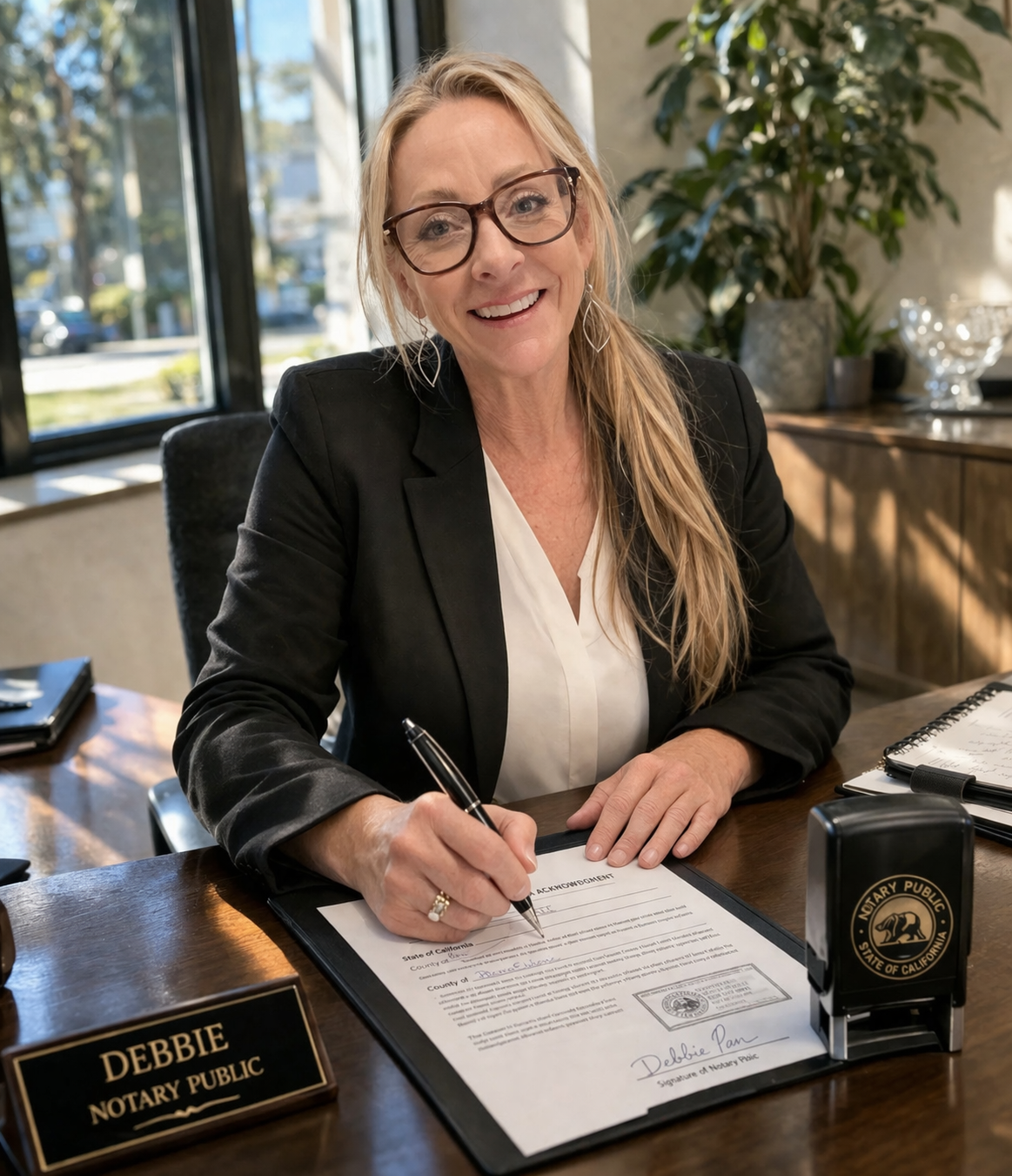
About the Author
Deborah Cuha
Licensed Utah Notary Public (Commission #742886) with 30+ years of experience. NNA Certified Loan Signing Agent and Certified Remote Signing Agent. Based in Park City, serving Summit, Wasatch, and Salt Lake counties.
Read Full Bio →